
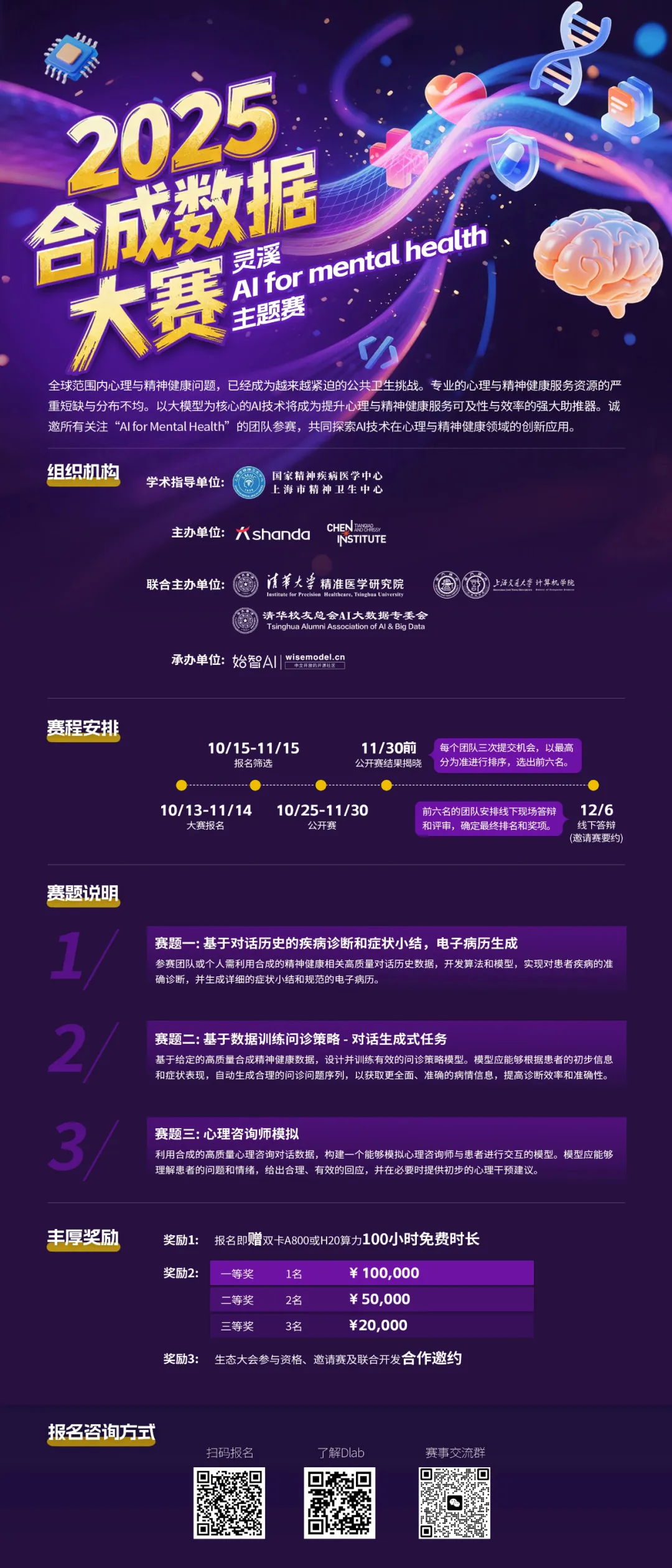
全球范围内心理与精神健康问题,已经成为越来越紧迫的公共卫生挑战。根据世界卫生组织最新发布的数据,全球超过10亿人遭受精神健康问题困扰。然而,专业的心理与精神健康服务资源仍然严重短缺与分布不均。
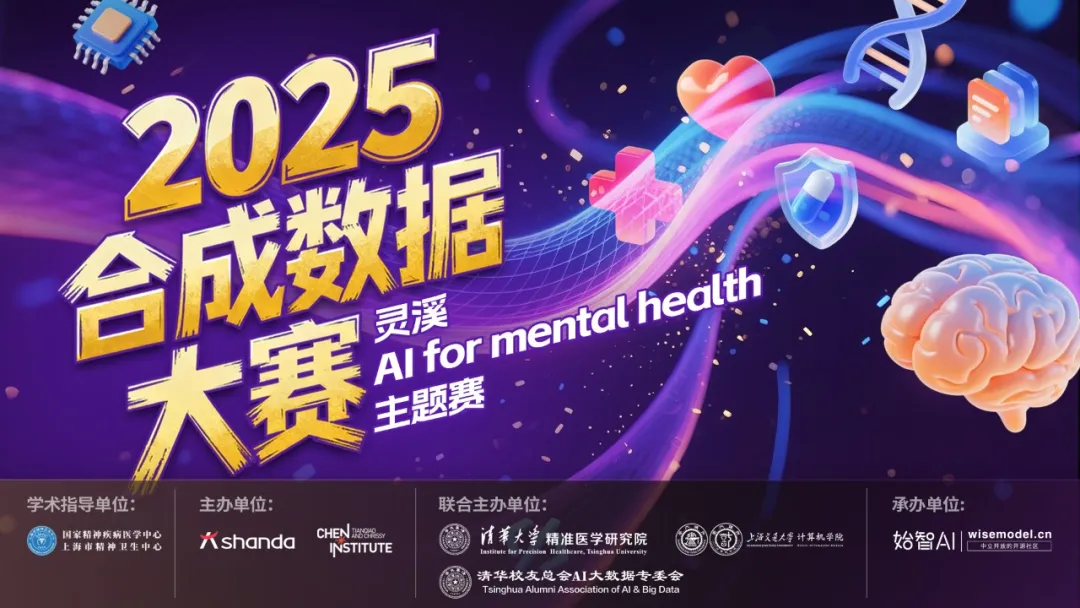
近来大模型技术的快速发展,以及拟人化能力越来越强,我们相信以大模型为核心的AI技术可以成为提升心理与精神健康服务可及性与效率的强大助推器。正是在此背景之下,“2025合成数据大赛·灵溪AI for Mental Health主题赛”应运而生,我们诚邀所有关注“AI for Mental Health”的团队参赛,共同探索AI技术在心理健康领域的创新应用。
赛题一:基于对话历史的疾病诊断和症状小结,电子病历生成
参赛团队或个人需利用合成的高质量精神健康相关对话历史数据,开发算法和模型,实现对患者疾病的准确诊断,并生成详细的症状小结和规范的电子病历。对话历史数据可能包括患者与医生、心理咨询师之间的交流记录,涵盖症状描述、病情发展过程、家族病史、生活习惯等丰富信息。疾病任务可分为抑郁症二分类以及多疾病多标签的诊断。
赛题二:基于数据训练问诊策略 – 对话生成式任务
基于给定的精神健康高质量合成数据,设计并训练有效的问诊策略模型。模型应能够根据患者的初步信息和症状表现,自动生成合理的问诊问题序列,以获取更全面、准确的病情信息,提高诊断效率和准确性。
赛题三:心理咨询师模拟
利用提供的心理咨询对话高质量合成数据,构建一个能够模拟心理咨询师与患者进行交互的模型。模型应能够理解患者的问题和情绪,给出合理、有效的回应,并在必要时提供初步的心理干预建议。
所有关注“AI for Mental Health”的企业、科研团队、独立开发者和在校生等,都可以报名参赛。每个团队成员数1-5人(可以有指导老师,指导老师不占成员数)。
大赛报名:2025年10月13日-2025年11月14日
报名筛选:2025年10月15日-2025年11月15日
公开赛:2025年10月25日-2025年11月30日
公开赛结果揭晓:2025年11月30日前,每个团队三次提交机会,以最高分为准进行排序,选出前六名进行现场答辩。
线下答辩及邀请赛要约:2025年12月6日(上海),灵溪人工智能与精神健康生态大会(http://lxdh.fumed.com.cn/m2025/)上,前六名的团队安排线下现场答辩和评审,确定最终排名和奖项,部分团队有机会获得邀请赛及合作要约。
特别说明:由于赛程安排相对紧张,公开赛阶段,每个团队最多有30天的开发时间,早报名且通过筛选进入公开赛的团队,将更早拿到开发的服务器,晚报名且通过筛选进入公开赛的团队,可能在11月30号前的开发时间不足30天。我们鼓励感兴趣的团队尽早完成报名。
1)前往大赛官网完成平台注册,认证手机号,并填写注册信息 https://wisemodel.cn/events/5jpq4q66n48nxpunypo3ti239xabg7
2)登录之后点击大赛页面上的“报名”按钮,会跳出报名信息填写的页面,完成报名信息的填写,上传CV或项目经验等材料,提交即可完成报名。提交之后的报名信息在审核确认前可以随时修改。
奖励1:报名即赠双卡A800或H20,100小时免费时长
奖励2:
一等奖 100000元 (1个)
二等奖 50000元 (2个)
三等奖 20000元(3个)
奖励3:生态大会参与资格、邀请赛及联合开发合作邀约
每个团队三次提交机会,以最高分为准进行排序,选出前六名晋级,参加线下答辩,根据现场答辩成绩确定最终排名和奖项。
(一)评审团队
由精神医学领域的资深专家、数据科学和机器学习领域的权威学者、经验丰富的心理咨询师以及行业内知名企业的技术负责人组成评审团队。评审团队成员将根据各自的专业领域和经验,对参赛作品进行全面、客观、公正的评估。
(二)评审标准细化
1)准确性
赛道一:疾病诊断准确率、症状小结相似度。
赛道二:问诊效率、信息获取有效性。
赛道三:回应准确性、干预有效性。
2)创新性
– 算法创新:评估参赛作品是否提出了新的算法或对现有算法进行了显著改进,如独特的神经网络架构、创新的数据处理方法等。
– 解决方案创新:考察参赛团队或个人在解决问题的思路、方法和应用场景方面的创新程度,如是否提出了全新的问诊策略框架、心理咨询交互模式等。
3)实用性
– 临床应用价值:判断参赛作品在实际精神健康诊疗和咨询场景中的可行性和应用潜力,如是否能够提高诊断效率、改善治疗效果、提升患者满意度等。
– 社会价值:考虑作品对推动精神健康领域发展、提高公众对精神健康问题的认知、促进社会和谐稳定等方面的贡献。
4)可解释性
– 模型可解释性:评估参赛团队或个人对模型决策过程和结果的解释能力,如是否能够解释模型如何进行疾病诊断、生成问诊策略或给出心理咨询回应。
– 解决方案易懂性:考察提交的文档和演示是否清晰、易懂,便于其他专业人员和非技术人员理解和应用参赛作品。
参赛团队和个人必须严格遵守数据使用协议,不得对数据进行任何形式的篡改、伪造或恶意使用。禁止使用外部数据增强或替换比赛提供的数据,确保比赛的公平性和数据的安全性。数据仅限于在大赛提供的服务器上使用,严禁以任何形式将数据对外传输。如发现违规行为,将立即取消参赛资格,并依法追究相关责任。
参赛团队和个人可自行选定使用开源模型,并在大赛提供的服务器上开展模型训练和部署工作,同时模型的使用需遵守相应的开源协议。如果是自有模型,包括之前基于开源模型微调之后未开源的模型,请提前跟大赛组织方报备相应情况。不得调用任何外部的大模型资源,即不可调用外部模型API。如发现违规行为,将立即取消参赛资格。
主办方有权在比赛相关的宣传、推广和研究中使用参赛作品的部分或全部内容,包括但不限于代码、模型、文档和成果展示等,无需另行支付费用。参赛团队或个人应保证其作品不侵犯他人的知识产权,如因作品侵权引发的法律纠纷,由参赛团队或个人自行承担全部责任。
主办方有权根据比赛的实际进展情况和需要,对比赛规则、赛程安排、奖项设置等内容进行适当的调整和变更。如有变更,将及时在比赛官方网站上发布通知,参赛团队和个人应密切关注网站信息,以最新通知为准。如参赛团队或个人对变更内容有异议,可在规定时间内与主办方协商,协商不成的,视为接受变更后的规则。
在比赛过程中,如参赛团队或个人之间发生争议,应首先通过友好协商解决;协商不成的,可以向比赛主办方提出申诉,主办方将组织专门的争议解决小组进行调查和处理。争议解决小组的决定为最终决定,参赛团队和个人应予以遵守。
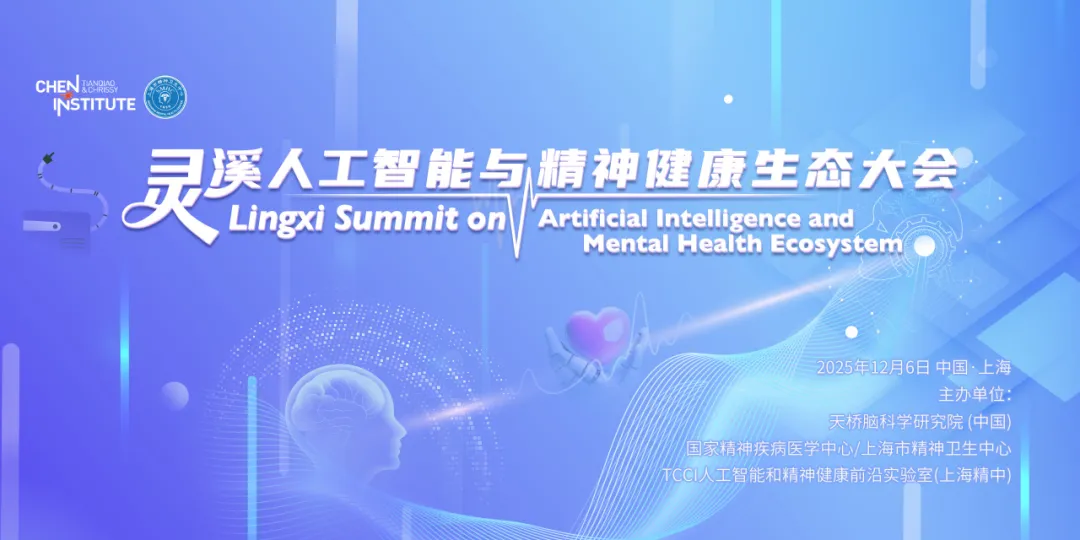
本次论坛由天桥脑科学研究院与上海市精神卫生中心联合主办,将于2025年12月6日在上海举行。论坛聚焦人工智能与精神健康的交叉前沿,汇聚权威专家、行业领袖、创新企业和政策制定者,致力于推动学术交流、技术突破与产业合作。
论坛内容涵盖心理健康评估中的多模态数据融合、人工智能智能体与机器人在治疗中的创新应用,以及大尺度大脑模型与神经调控等前沿议题。圆桌讨论将围绕人机协作在心理健康护理中的创新模式展开,激发跨界思维和实践探索。
活动还将设有产品互动展示,参会者可体验并评选最具创新力的产品。创业公司路演为新兴企业提供展示与交流平台,助力项目对接投资与资源。平行分论坛将聚焦人工智能与精神健康领域的安全与伦理挑战,邀请科技政策、AI伦理、医学技术及数据科学等领域的专家深入交流与观点碰撞。
论坛还将为嘉宾和获奖团队搭建高端交流平台,促进思想分享与合作共赢。此次盛会将推动人工智能与精神健康领域的持续创新与协同发展。
时间:2025年12月6日
地点:上海市精神卫生中心(宛平南路600号)
主办方:
天桥脑科学研究院 (中国)
国家精神疾病医学中心/上海市精神卫生中心
TCCI人工智能和精神健康前沿实验室(上海精中)
口号
聚智成溪,润泽心灵
更多会议信息请扫描下方二维码:

温馨提示
本次会议现场座位数量有限,我们将在会前以短信及邮件的方式通知能现场参与的参会者。清注意查收。
论坛主题包括但不限于:
已确认讲者嘉宾:
更多重磅嘉宾敬请期待!
20位科技政策、AI和医学技术伦理、数据科学、AI技术专家的观点交锋和论剑。
路演入围团队的交互展示
Demo Day路演环节
Demo Day项目报名,请邮件联系:
genghaiyang@cheninstitute.org
路演团队领域包括但不限于:AI智能体、AI智能硬件、CBT智能体、医疗硬件和筛查算法、互联网医院、AI伴侣、AI潮玩、AI音乐疗愈、心理大模型研发、AI制药等

数据大赛报名入口


扫码即可注册参会!
申报大奖
2026年天桥脑科学研究院与《科学》杂志AI驱动科学大奖申报通道已开放,申请者需提交一篇 1000 字的研究论文,详细说明他们的研究如何使用人工智能来驱动科学进步。更多大奖详情,请参见:2026年天桥脑科学研究院与《科学》杂志AI驱动科学大奖申报通道开放
加入社区
欢迎加入我们的 AI 驱动科学社区,成为天桥脑科学研究院 AIAS 联盟成员,以获得更多权益。
申请邮箱:
AItalents@cheninstitute.org
展示机会
AIAS联盟成员将有机会在本次会议上发表演讲,参与圆桌讨论,并与AI for Science领域的行业领袖与卓越青年科学家共同出席闭门交流晚宴。
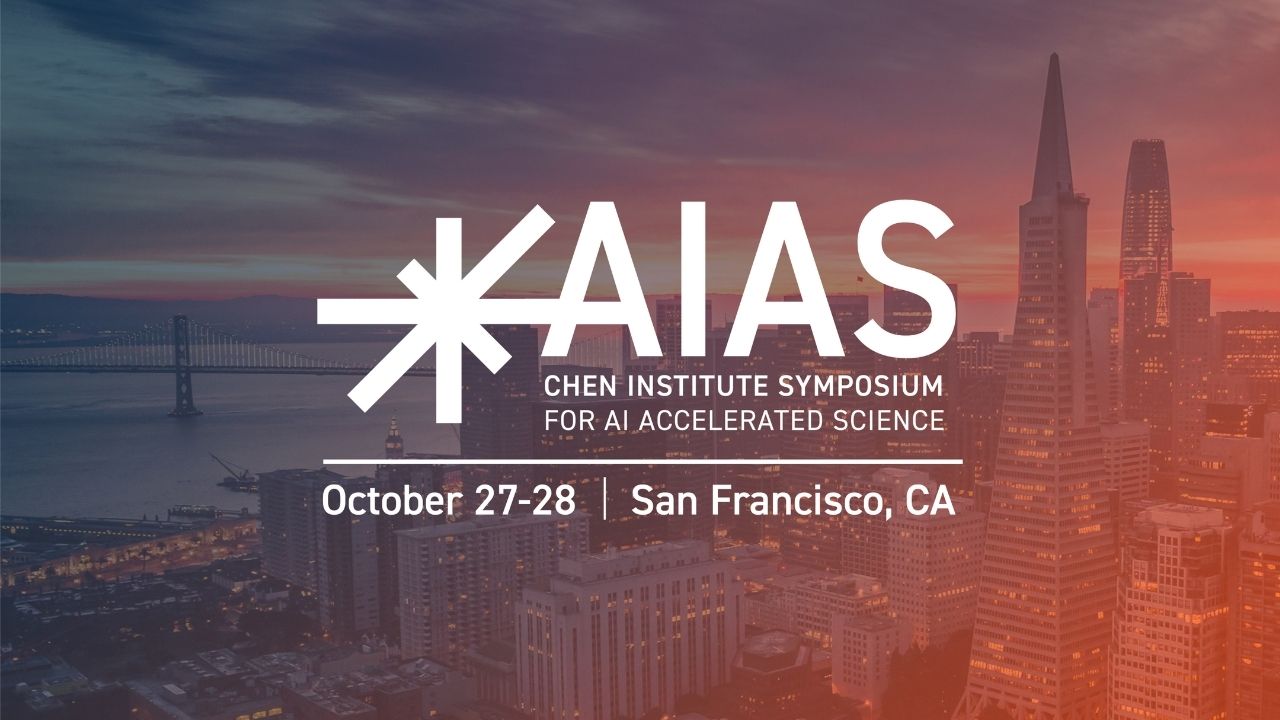
由天桥脑科学研究院主办的首届AI 驱动科学年度研讨会 (AIAS 2025)将于 10 月 27–28 日在美国旧金山举行。会议面向全球征集论文,聚焦能够在科学领域开辟全新研究模式、假设生成及实验方法的变革性人工智能创新。
如果您希望与诺贝尔奖得主Jennifer Doudna,David Baker,知名学者Animashree Anankumar,Heather J. Kulik,以及业界领袖Tom Miller一同登台分享,请提交您的论文!
征稿截止日期为 8 月 1 日。

天桥脑科学研究院(Tianqiao and Chrissy Chen Institute)今日(6 月 9 日)宣布,“AIAS 2025:AI 驱动科学研讨会”现已开放免费注册,活动将于 10 月 27 日至 28 日在旧金山举行。请访问 www.AIAS2025.org 报名参会。
Jennifer Doudna(诺贝尔化学奖得主、加州大学伯克利分校李嘉诚生物医学与健康科学讲席教授、生物化学、生物物理及结构生物学教授)与 David Baker(诺贝尔化学奖得主、华盛顿大学蛋白质设计研究所所长、Henrietta and Aubrey Davis 冠名生物化学讲席教授)将与知名学者及业界领袖同台交流。
其他已确认发言嘉宾包括:
研讨会将探讨人工智能领域的核心进展如何加速科学突破,重点展示推动科学研究范式变革的 AI 创新,包括全新推理、假设生成与跨学科实验方法。
重点议题包括:
参会免费,但需提前注册。注册者将获得大会最新议程及相关信息。
立即注册:www.AIAS2025.org
AI驱动科学大奖:www.cheninstitute.org/prize

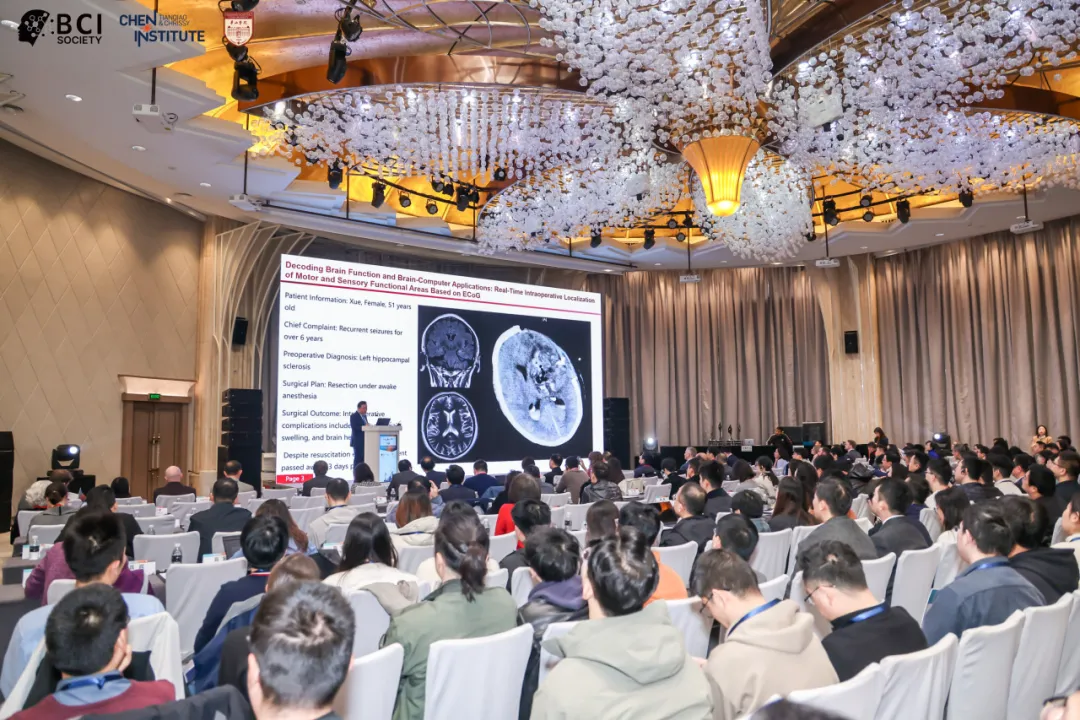
12月6日-7日,由天桥脑科学研究院(Tianqiao and Chrissy Chen Institute)与BCI协会(BCI Society)联合主办,复旦大学附属华山医院(国家神经疾病医学中心)特别支持的”BCI Society & Chen Institute Joint Meeting”在中国上海黄浦区举办,标志着这一国际顶级学术会议在创办25年后首次落户亚洲。
为期两天的会议吸引了近400位来自全球的科学家、临床医生和产业界人士,共同探讨脑机接口技术的前沿突破与产业化前景。
天桥脑科学研究院创始人雒芊芊表示:“期待与BCI协会携手合作,共同推动全球脑机接口领域的交流。这次大会不仅是展示领域最新研究成果的重要平台,更是连接全球智慧、激发创新思维的难得契机。”
雒芊芊介绍,天桥脑科学研究院积极支持中国脑机接口研究和产业,除了主办这次国际会议,近年来还举办了中外院士论坛脑机接口专场、中国神经科学学会年会BCI+AI主题论坛,面向健康大众的脑机接口论坛、脑机接口与哲学研讨会、科幻小说与脑机接口科普讲座等,吸引线下参会者近2000人次,线上直播观众近300万人次。
同时,研究院与华山医院合作建立应用神经技术前沿实验室,资助支持了脑机接口中文语言解码、运动解码、治疗渐冻症等多项研究和iBrain脑电联盟,不少已取得重要成果。盛大集团和研究院投资孵化了脑虎科技,研发的侵入式柔性脑机接口技术获得2021年世界人工智能大会最高奖项SAIL奖,已经成为中国侵入式BCI领域的领头企业。
▷复旦大学附属华山医院院长毛颖教授
目前,研究院正热忱欢迎优秀AI的人才加入,共同开启BCI研究的的新纪元。投递到talents@cheninstitute.org的简历,将由创始人陈天桥、雒芊芊亲自阅读。
BCI协会主席Mariska Vansteensel强调了此次会议的重要意义:“此前,全球脑机接口研究社区的互动交流相对有限。本次会议的举办,不仅为整个行业搭建了一个全方位的交流平台,更是践行了我们’促进全球脑机接口研究’使命的重要一步。”
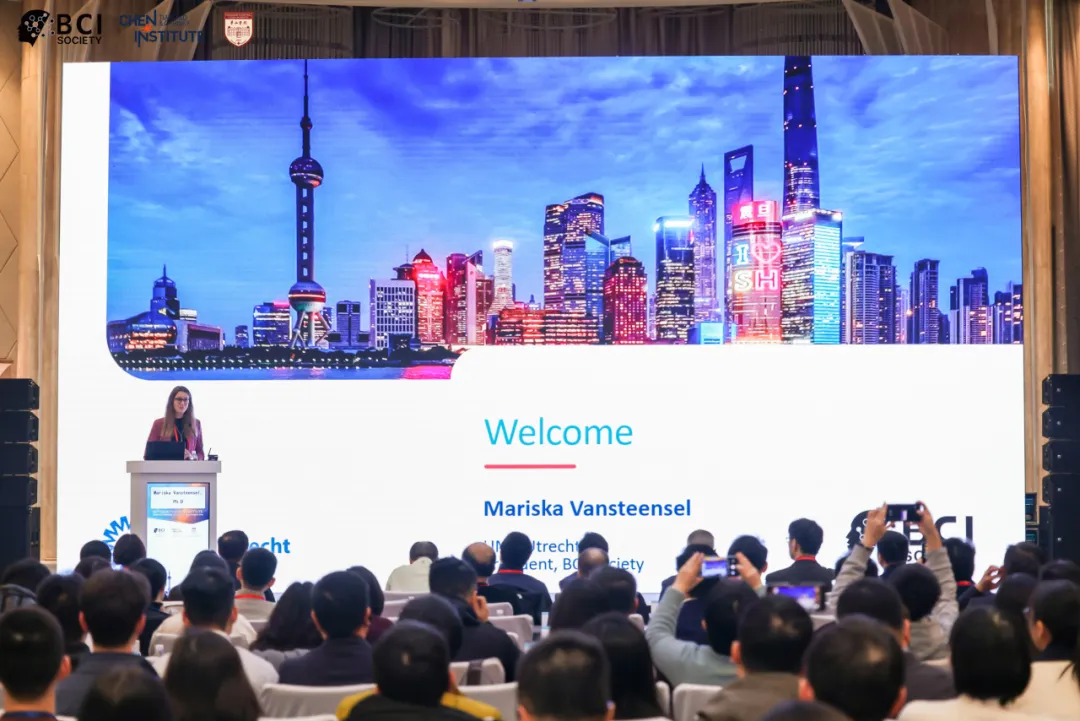
▷BCI协会主席Mariska Vansteensel
本次大会议程设置全面而深入,涵盖从基础研究到临床应用、从技术开发到产业转化的完整创新链条。会议期间举办的十余场主题演讲,邀请到多位国际知名专家,就神经技术、脑科学与人工智能等前沿领域展开深入探讨。专家们重点分享了脑机接口在神经康复、临床医疗与人类能力增强等方面的创新应用与突破性进展。
会议上,复旦大学附属华山医院院长毛颖教授、瑞士洛桑大学医院的Jocelyne Bloch、Grégoire Courtine教授以及清华大学生物医学工程学院洪波教授,分享了各自在应用BCI技术帮助运动障碍患者恢复运动与交流功能方面的相关研究进展。
毛颖教授介绍了华山医院通过DBS用于帕金森病等中枢神经系统疾病患者的运动障碍的治疗思路与实践,据悉国内已有数百位患者从中获益。Jocelyne Bloch、Grégoire Courtine教授介绍了他们啮齿动物模型中发现脊髓硬膜外电刺激调节特定神经元群活动机制,并由此设计出一套可用于人类的治疗模式,以恢复脊髓损伤或帕金森病患者的行走和上肢功能。洪波教授则在此次BCI会议上着重介绍了其团队开发的微型硬膜外脑机接口植入物“NEO系统”进入人体临床研究阶段后的最新进展。
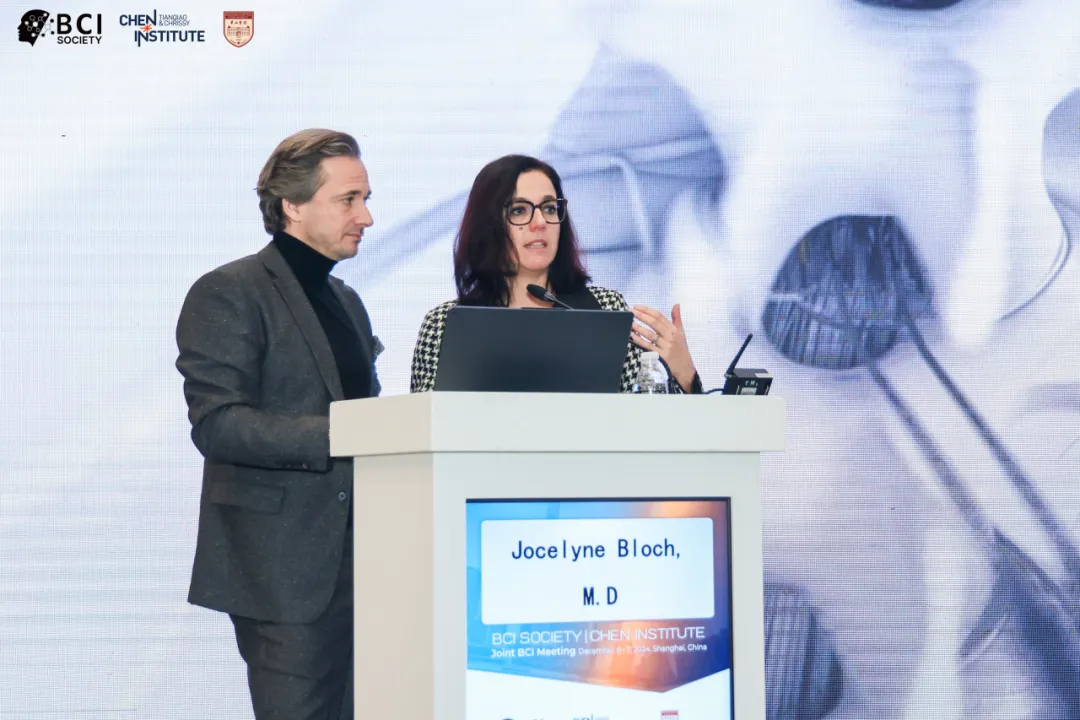
▷Jocelyne Bloch、Grégoire Courtine教授
值得一提的是,大会特别设立了青年科学家论坛单元,为新生代研究者提供了展示创新思维、分享研究成果的专属平台,进一步激发了领域的创新活力。
来自复旦大学的宋恩名博士探讨了柔性、植入式电子系统在慢性神经接口中的应用,强调了硅基CMOS系统的高集成度和长期稳定性的重要性。天津大学的许敏鹏博士则介绍了无创脑机接口的发展与挑战,分析了当前技术的瓶颈和未来的研究方向。浙江大学的杨雨潇博士关注于治疗抑郁症的侵入式脑机接口,提出了通过神经调节改善患者心理健康的新方法。最后,来自弗赖堡大学的Natalie Mrachacz-Kersting博士分享了为神经康复设计的脑机接口,展示了其在促进患者康复中的潜力。青年科学家们带来的报告,展现了BCI技术在不同应用领域的多样性和前景。
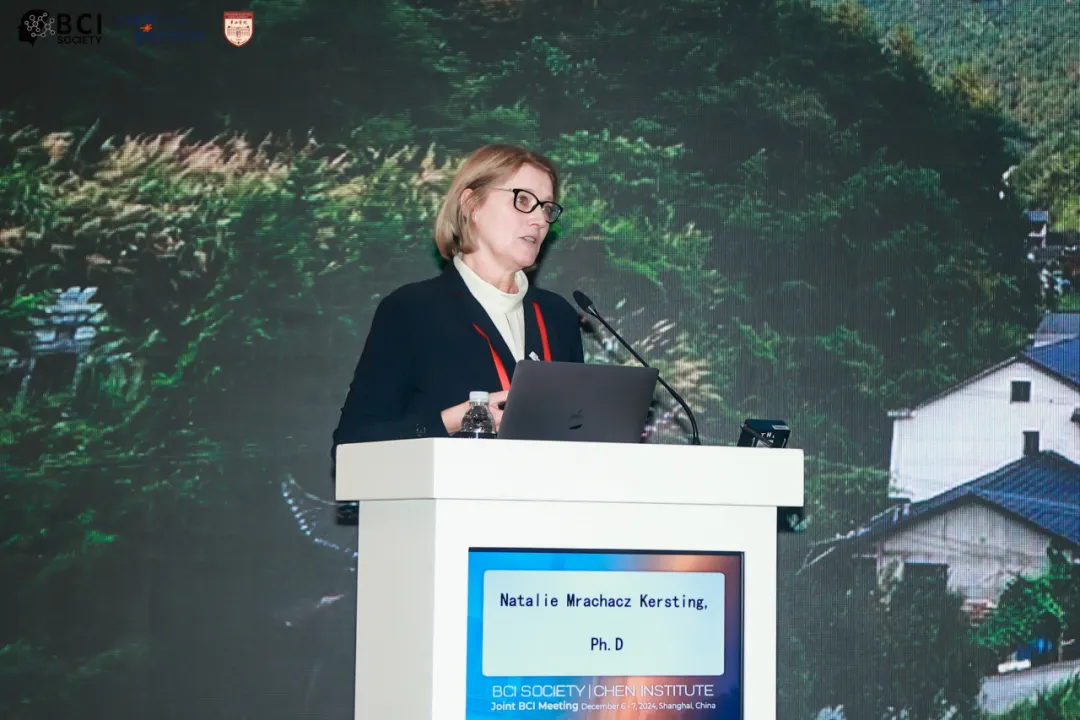
▷Natalie Mrachacz-Kersting博士
通过为期两天的深度交流与思想碰撞,与会专家们不仅展示了脑机接口技术在医疗健康、人类能力提升等领域的广阔应用前景,更为该领域的未来发展描绘了令人期待的蓝图。这次会议的成功举办,不仅标志着全球脑机接口研究进入新阶段,也凸显了中国在该领域的影响力与发展潜力。正如中科院蒲慕明院士所言,“通过神经网络的重塑实现信息的高效传递,这不仅是揭示大脑功能的关键,也是开发新型治疗手段的重要途径。”
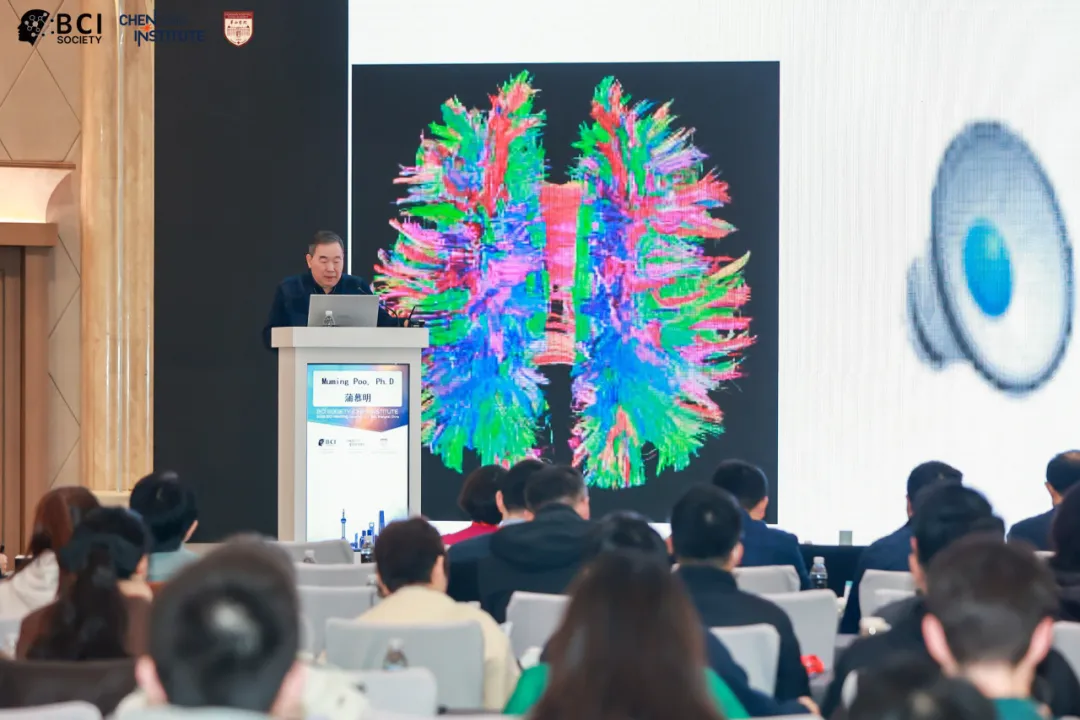
▷中科院蒲慕明院士
感谢以下合作方为”BCI Society & Chen Institute Joint BCI Meeting”提供的支持:

今年12月6日和7日,天桥脑科学研究院(Tianqiao and Chrissy Chen Institute, TCCl)与BCI协会(BCI Society)将在中国上海合作举办BCI Society & Chen Institute Joint BCI Meeting,标志这一全球脑机接口领域顶级学术会议创办25年后首次落户亚洲。大会将汇聚全球顶尖学者与前沿研究团队,打造一个开放创新的学术交流平台,推动跨学科合作和全球对话,致力于脑机接口技术的科学突破与产业化应用,加强亚洲与全球研究人员的深度互动,共同构建一个真正的全球脑机接口社区。
大会议程涵盖从基础研究到临床应用、从技术开发到产业转化的多个层次,展示脑机接口领域的前沿突破和未来发展趋势。会议期间将举办十余场主题演讲,邀请来自全球知名学术与研究机构的重要学术领袖与行业先锋,共同分享他们在神经技术、脑科学与人工智能的最新研究成果,深入探讨脑机接口在神经康复、临床医疗与人类能力增强等方面的应用前景与挑战。
大会特别重视跨学科合作与行业交流,设置了丰富的社交环节,为与会者提供轻松的交流平台,促进来自不同领域专家之间的深度对话、经验分享与合作机会的探索。
2024国际脑机接口大会将以丰富的内容和多样的形式,带来关于脑机接口未来的深度探讨与前瞻性思考。我们诚邀全球神经科学、临床、人工智能、数据、新材料、集成电路等相关领域的科学家及产业界的同行参会,共同见证脑机接口技术如何重新定义未来,推动人类认知边界的进一步拓展。
演讲嘉宾
Jocelyne Bloch, MD
Neurosurgeon, Lausanne University Hospital
Full Professor at Faculty of Life Science at Ecole Polytechnique Fédérale de Lausanne (EPFL)
Founder and Director of Defitech Center at Defitech Center for Interventional Neurotherapies
Chief Scientific Officer at ONWARD Medical N. V.
Grégoire Courtine, Ph.D.
Full Professor at Faculty of Life Science at Ecole Polytechnique Fédérale de Lausanne (EPFL)
Adjunct Professor at Neurosurgical Department at University Hospital Lausanne
Founder and Director of Defitech Center at Defitech Center for Interventional Neurotherapies
Chief Scientific Officer at ONWARD Medical N. V.
Jocelyne Bloch is neurosurgeon at the University Hospital Lausanne (CHUV) where she leads the functional neurosurgery unit, while Grégoire Courtine is a neuroscientist with a background in physics. Jocelyne and Grégoire are Professor within the NeuroX institute of the Ecole Polytechnique Fédérale de Lausanne (EPFL), within the neurosurgical department of CHUV, and at the Faculty of Medicine of the University of Lausanne (UNIL). Together, they founded the Defitech Center for Interventional Neurotherapies, named .NeuroRestore, which develop bioengineering strategies involving neurosurgical interventions to restore neurological functions. In 2014, they also co-founded ONWARD Medical (Euronext: ONWD) with the aim to translate the neurotherapies developed at .NeuroRestore into clinical treatments. Jocelyne and Grégoire are known worldwide for the conception of neuroprosthetic implants that restored walking in people with chronic paralysis.
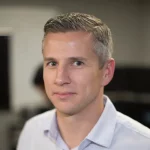
Robert Gaunt, Ph.D.
Associate Professor and Engineering Director, Rehab Neural Engineering Labs,
Department of Physical Medicine and Rehabilitation at the University of Pittsburgh
Associate Professor, Physical Medicine and Rehabilitation, Department of Biomedical Engineering at Carnegie Mellon University
Robert Gaunt is an Associate Professor of Physical Medicine and Rehabilitation at the University of Pittsburgh. He holds a BEng in Mechanical Engineering from the University of Victoria and a PhD in Biomedical Engineering from the University of Alberta. Dr. Gaunt’s research focuses on neuroprosthetics for sensorimotor control of the hand and bladder, aiming to restore function after injury or disease. His work includes developing brain-computer interfaces to enable movement and sensation for those with upper-limb paralysis and creating neural interfaces to regulate bladder function. Recognized by the National Academy of Engineering, his research has been featured widely in media, and he holds multiple patents.
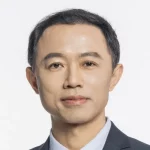
Bo Hong, Ph.D.
Professor, Department of Biomedical Engineering, Tsinghua University
Principle Investigator, McGovern Institute for Brain Research
Dr. Bo Hong received his Ph.D. degree of Biomedical Engineering from Tsinghua University in 2001. From 2004 to 2005, he was a visiting scientist in the Department of Biomedical Engineering and the Center for Neural Engineering at Johns Hopkins University, USA. He is now full professor with School of Biomedical Engineering, Tsinghua University, and an investigator of McGovern Institute for Brain Research at Tsinghua. His main research interests are brain computer interface and language network in human brain. His team designed and developed minimally invasive BCI – NEO system and conducted the first-in-human clinical trial successfully in 2023. He has co-authored more than 80 papers on Nature Neuroscience, PNAS, Nature Communications, NeuroImage, Journal of Neuroscience etc. He has served as the Associate Editor of IEEE Transactions on Biomedical Engineering and IEEE Transactions on Neural Systems and Rehabilitation Engineering.

Cory Inman, Ph.D.
Professor, Department of Biomedical Engineering, Tsinghua University
Principle Investigator, McGovern Institute for Brain Research
Director, Immersive Neuromodulation and Neuroimaging (INMAN) Laboratory in the Psychology
Department at the University of Utah
Dr. Cory Inman is the director of the Immersive Neuromodulation and Neuroimaging (INMAN) Laboratory in the Psychology Department at the University of Utah. He received his BA in Psychology from Georgia State University and his PhD from Emory University. He completed his first postdoctoral fellowship in the Neurosurgery department at Emory University and a second postdoctoral fellowship at UCLA. He has broad interests in helping to establish approaches that push our understanding of emotion and memory from the laboratory into the wild, real world. The INMAN Lab is currently undertaking studies examining the use of direct brain stimulation to the human amygdala for episodic memory enhancement and direct brain recordings of deep memory structures, like the hippocampus during, navigation and autobiographical memory encoding in real-world settings. Outside the lab, he spends his time playing with his 2 kids, playing guitar, playing basketball, and exploring as many outdoor adventures as possible including white water rafting, snowboarding, hiking, and climbing.

Camille Jeunet-Kelway, Ph.D.
CNRS Research Scientist
INCIA, University of Bordeaux & CNRS, France
Deputy head of the SMART platform, University of Bordeaux
Camille Jeunet-Kelway received her PhD in cognitive sciences in 2016 at the University of Bordeaux, France. After a post-doctoral fellowship in Inria (Rennes, France) and EPFL (Geneva, Switzerland), she was recruited as a tenured CNRS Research Scientist. In 2021, she has joined the institute for cognitive and integrative neurosciences (INCIA) in Bordeaux, where she leads interdisciplinary research on the use of EEG-BCIs to improve or restore cognitive and motor abilities, both for clinical (stroke patients and patients with Parkinson disease) and non-clinical (athletes) populations. She is particularly interested in studying the learning mechanisms underlying neurofeedback training as well as the acceptability of neurofeedback procedures and BCI technologies. Camille Jeunet-Kelway has received 3 PhD awards, the European Label as well as 5 national fundings from the French research agency for her research. In 2022 she was awarded the Early Career Award in neuroscience from the BCI Society. Since 2024, she is deputy head of the SMART reasearch and innovation plateform, an “intelligent, connected gym”, dedicated to sports and movement sciences.
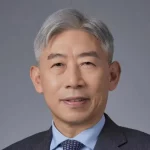
Bao-Liang Lu, Ph.D.
Director for the Center for Brain-Like Computing and Machine Intelligence
The Key Laboratory of Shanghai Education Commission Intelligent Interaction
Cognitive Engineering, and Ruijin-Mihoyo Laboratory
Bao-Liang Lu received his PhD in electrical engineering from Kyoto University, Kyoto, Japan, in 1994. Since August 2002, he has been a full professor at the Department of Computer Science and Engineering, Shanghai Jiao Tong University, China. He currently serves as the Director for the Center for Brain-Like Computing and Machine Intelligence, the Key Laboratory of Shanghai Education Commission Intelligent Interaction and Cognitive Engineering, and Ruijin-Mihoyo Laboratory. He received the 2018 IEEE Transactions on Autonomous Mental Development Outstanding Paper Award and the 2021 Best of IEEE Transactions on Affective Computing Paper Collection. He is also the Associate Editor of the IEEE Transactions on Affective Computing and Journal of Neural Engineering and an IEEE Fellow. His research interests include deep learning, large EEG model, emotion artificial intelligence, and affective brain-computer interface.
Natalie Mrachacz-Kersting, Ph.D.
Director, Laboratory for Brain-Computer Interfaces and Neurorehabilitation, Albert-Ludwigs-University Freiburg
Chair of Neuroscience in Sport and Movement, Institute for Sport and Sport Science
VP of MAC, IEEE Engineering in Medicine and Biology Society
Deputy Editor-in-Chief, IEEE TNSRE
Prof. Dr. Natalie Mrachacz-Kersting, a member of IEEE, received her Ph.D. degree in biomedical engineering from Aalborg University in 2005. She currently holds the Chair for Neuroscience and Neuroscience in Sport at the Albert-Ludwigs University of Freiburg and is a member of the BrainLinks-BrainTools Cluster of Excellence at IMBIT, Albert-Ludwigs University of Freiburg. Dr. Mrachacz-Kersting serves on the Executive Committee of the IEEE Engineering in Medicine and Biology Society (EMBS) as the Vice President-elect for Member and Student Activities. She is also the Chair of the IEEE Women in Biomedical Engineering (WI(BM)E), member of the Steering Committee of IEEE Brain Technical Community, and the Deputy Editor-in Chief of the IEEE Transactions on Neural Systems and Rehabilitation Engineering Journal. She has previously held positions at Aalborg University in Denmark, FH Dortmund in Germany, and the University of Auckland in New Zealand. Dr. Mrachacz Kersting’s research focuses on medical technology, biomedical engineering, and neuroscience. She has authored over 80 peer-reviewed journal articles, more than 130 conference papers and abstracts, ten book chapters, and one book. Her current projects primarily involve Brain-Computer Interfaces (BCIs) for patient populations, including those suffering from stroke or ALS. Dr. Mrachacz-Kersting received several awards including the international BCI award in 2017.
Mu-ming Poo, Ph.D.
Scientific Director, Institute of Neuroscience, Chinese Academy of Sciences (CAS)
Director, Shanghai Center for Brain Science and Brain-Inspired Technology
Paul Licht Distinguished Professor in Biology Emeritus, University of California, Berkeley
Mu-ming Poo is the Scientific Director of Institute of Neuroscience, Chinese Academy of Sciences (CAS), Director of Shanghai Center for Brain Science and Brain-Inspired Technology, and Paul Licht Distinguished Professor in Biology Emeritus at University of California, Berkeley. He studied physics at Tsinghua University in Taiwan and received PhD in biophysics from Johns Hopkins University in 1974. During 1976-2012, He had served on the faculty of UC Irvine, Yale, Columbia, and UCSD, and UC Berkeley. He was the founding director of Institute of Neuroscience, CAS (1999-2019), and a member of Chinese Academy of Science, Academia Sinica, and Hong Kong Academy of Science, and an international member of US National Academy of Science. He was awarded Ameritec Prize, International Science & Technology Cooperation Award of P. R. China, and Gruber Neuroscience Prize. Poo’s research interest includes axon growth, synaptic plasticity, and the use non-human primates to study higher cognitive functions and human brain disorders. He is the Executive Editor-in-Chief of National Science Review and the editorial board member for many journals, including Neuron and Progress in Neurobiology.
Mao Ying, MD
President of Huashan Hospital at Fudan University
Dr. Ying Mao is a highly respected neurosurgeon at Huashan Hospital in Shanghai, China. He now serves as the director of the National Center for Neurological Disorders, the chairman-designate of the Neurosurgery Section of the Chinese Medical Association and the president of Huashan Hospital. With years of experience under his belt, Dr. Mao is known for his expertise in treating complex neurological conditions and performing advanced brain surgeries. Patients appreciate his compassionate approach and his dedication to staying at the forefront of medical technology and techniques. Beyond the operating room, Dr. Mao is an avid researcher, contributing significantly to the field of neurosurgery with numerous publications and studies. He’s also a beloved mentor, guiding the next generation of neurosurgeons with his wealth of knowledge and experience. When he’s not working, Dr. Mao enjoys spending time with his family, exploring new culinary delights, and indulging in a good book. His commitment to his patients, coupled with his warm personality, makes him a standout figure in the medical community.
Alexander von Lühmann, Ph.D.
Head of Independent Research Group
BIFOLD-ML | Machine Learning Department
Technische Universität Berlin
Alexander von Lühmann is currently head of the “Intelligent Biomedical Sensing” research group at TU Berlin’s Machine Learning department and BIFOLD. He is also a visiting researcher at the Neurophotonics Center of Boston University (BU NPC) and the Lead Technology Advisor at NIRx Medical Technologies. Before this, he was the Chief Science Officer and R&D Director at NIRx for 2,5 years, a post-doc at Boston University, a visiting researcher at Harvard Medical School, and the Chief Technology
Officer at Crely, a healthcare startup based in the US and Singapore. He is a member of the ISO/DIN, SfNIRS, OPTICA, OHBM and VDI. His contributions to the field have been recognized by the fNIRS Society (Early Investigator Award 2022), the TU Berlin BIMOS graduate school (PhD Award 2019), the German Society for Biomedical Engineering (DGBMT Klee Award 2018) and the IEEE Biomedical Engineering Society (Special Feature & Cover Article 2017). He received his PhD (Dr.-Ing.) with distinction in 2018 from TU Berlin, and his M.Sc. and B.Sc. degrees in Electrical Engineering from Karlsruhe Institute of Technology in 2014/11.
青年科学家
Enming Song, Ph.D.
Associate Professor at Institute of Optoelectronics of Fudan University
Enming Song is an Associate Professor at the Institute of Optoelectronics, Fudan University. Previously, he was a postdoctoral fellow at Northwestern University’s Simpson Querrey Institute and an Adjunct Research Assistant Professor at the University of Illinois at UrbanaChampaign. He earned his Ph.D. and B.S. from Fudan University’s Department of Materials Science. His research focuses on soft electronic materials for biomedical engineering, particularly flexible bioelectronic systems for neural interfaces. Over the past five years, he has published 21 scientific papers and holds a U.S. patent. His contributions earned him honors like MIT Technology Review’s Innovators Under 35 Asia Pacific, Shanghai Science & Technology 35 Under 35, and a Global Innovation Award from UNIDO.
Minpeng Xu, Ph.D.
Associate Dean of Academy of Medical Engineering and Translational Medicine and Chair Professor of
Department of Biomedical Engineering at Tianjin University
Minpeng Xu received the B. S. and Ph. D. degrees in biomedical engineering from Tianjin University in 2010 and 2015, respectively. He visited the Tzyy-Ping Jung’s lab at the Institute for Neural Computation (INC) of University of California, San Diego (UCSD) from 2014 to 2015. He is currently the Associate Dean of Academy of Medical Engineering and Translational Medicine and Chair Professor of Department of Biomedical Engineering at Tianjin University. His research interests include brain-computer interface, neural signal processing and neuromodulation. He has published more than 80 academic papers as the (co-)first or (co-)corresponding author, and some of them were selected as ESI highly cited papers, IEEE TBME cover story, and JNE highlight.
Yuxiao Yang, Ph.D.
Assistant Professor, MOE Frontier Science Center for Brain Science and Brain-Machine Integration and
the State Key Laboratory of Brain-Machine Intelligence, Zhejiang University
Yuxiao Yang is an Assistant Professor at the MOE Frontier Science Center for Brain Science and Brain-machine Integration and the State Key Laboratory of Brain-machine Intelligence, Zhejiang University. Prior to joining Zhejiang University, he was an Assistant Professor of Electrical and Computer Engineering (ECE) at the University of Central Florida (UCF). He received a Ph.D. degree in ECE from University of Southern California in 2019 and received a B.S. degree in Electronics Engineering from Tsinghua University in 2013.His research centers on designing closed-loop brain-machine interface systems for neural decoding and control, aiming to provide new therapies for neurological and neuropsychiatric disorders. He has published in prestigious neural engineering journals, including cover articles in Nature Biotechnology and Nature Biomedical Engineering. He received the Annual Brain Computer Interface Award in 2019 and the IEEE EMBS Best Student Paper Award in 2015.
项目委员会及主持人
Cuntai Guan, Ph.D.
Program Committee and Moderator
President’s Chair in Computer Science and Engineering
Deputy Dean, College of Computing and Data Science
Nanyang Technological University, Singapore
Professor Cuntai Guan is a President’s Chair in Computer Science and Engineering and Deputy Dean of the College of Computing & Data Science at the Nanyang Technological University, Singapore. He is the Director of the Centre for BrainComputing Research, Director of the Artificial Intelligence Research Institute, CoDirector of S-Lab for Advanced Intelligence, and Co-Director of the Rehabilitation Research Institute of Singapore. His research interests include Brain-Computer Interfaces (BCI), Machine Learning, Neural Signal & Image Processing, and Artificial Intelligence. He is a recipient of several awards owing to his contributions to Brain Computer Interface research.
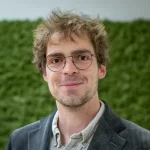
Christian Herff, Ph.D.
Program Committee and Moderator
Assistant professor, Mental Health and Neuroscience Research Institute
Maastricht University, the Netherlands
Dr. Christian Herff is an assistant professor in the Mental Health and Neuroscience Research Institute at Maastricht University where he leads the Neural Interfacing Lab. His research interest lays in the application of machine learning technology to neurophysiological data for Brain-Computer Interfaces and neuroscience research. With a particular focus on the decoding of speech processes from intracranial data, he tries to improve the lives of severely paralyzed patients while simultaneously improving our understanding of complex higher order cognition. He emphasizes the ability to achieve interpretable results based on computational models. In particular, visualization of complex dynamic models, such as deep neural networks, is of interest to him.
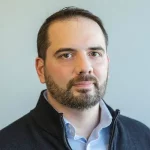
Dean J. Krusienski, Ph.D.
Program Committee and Moderator
Professor and Graduate Program Director
Department of Biomedical Engineering
Virginia Commonwealth University, USA
Dean Krusienski is a Professor and Graduate Program Director of Biomedical Engineering at Virginia Commonwealth University in Richmond, Virginia, where
he also directs the Advanced Signal Processing in Engineering and Neuroscience (ASPEN) Laboratory. He has co-authored over 100 peer-reviewed publications related to advancing brain-computer interface and neural signal analysis techniques, which have collectively received over 11,900 citations. His lab’s work has been funded by NSF, NIH, NASA/NIA and DoD, including current projects on intracranial speech decoding and synthesis; closed-loop DBS; biomarkers of hippocampal and sleep pathologies; user-state estimation; visual, auditory, and memory processing; and virtual reality applications.
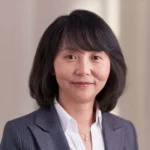
Yan Li, Ph.D.
Program Committee and Moderator
Executive Director of Scientific Programs
Dr. Yan Li serves as the Executive Director of Scientific Programs at the Tianqiao Chen & Chrissy Luo Institute (TCCI®). She oversees the daily management of the Institute’s initiatives and fosters strong communications with beneficiary organizations and individuals. In addition to collaborating with cornerstone partners, Yan is spearheading the development of programs that empower researchers at all stages of their careers, advancing the overarching mission of the foundation to drive innovation and discovery. Dr. Li received her Ph.D. in Neuroscience at the Institute of Neuroscience, Chinese Academy of Sciences at Shanghai. She spent six years as a postdoctoral fellow at Profession Fred H. Gage’s lab at the Salk Institute and then moved to Stanford where she worked with Professor Thomas Sudhof and Marius Wernig for two years. Prior to joining Chen Institute, Dr. Li worked at a startup company at Menlo Park, California.

Mariska Vansteensel, Ph.D.
Program Committee and Moderator
Assistant Professor, University Medical Center Utrecht, the Netherlands
President, International BCI Society
Mariska Vansteensel is an Assistant Professor at the UMC Utrecht Brain Center in Utrecht. Her main research goal is to use the wealth of neuroscientific knowledge directly for the benefit of people with disease or disability. The main focus of her research since 2007 has been the development and validation of implantable electrocorticography (ECoG)-based Brain-Computer Interfaces (BCI) for communication in individuals with severe motor and speech impairment. She has conducted research on the proof of concept, working with epilepsy patients who receive ECoG electrodes for diagnostic purposes and on the first worldwide investigation of the use of fully implantable BCIs in settings of daily living of people with severe motor impairment.

Theresa M. Vaughan, BA
Program Committee and Moderator
Research Scientist
National Center for Adaptive Neurotechnologies
Albany Stratton VA Medical Center, USA
Theresa Vaughan is a research scientist with thirty years of experience in clinical research studies, 25 years focused specifically on brain-computer interfaces (BCIs) as new communication channels for people with severe motor disabilities. Her laboratory supervised the first-ever large-scale trial of independent home use of a BCI by people with amyotrophic lateral sclerosis (ALS). This work has become the foundation of the National Center for Adaptive Neurotechnologies (NCAN) translational service project program. To accomplish this, they have developed and tested hardware; modified the BCI2000 software; developed a range of Windows-based applications; produced training tools for therapists, caregivers, and users; and designed software.
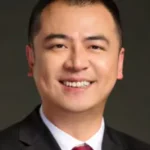
Tao Hu, Ph.D
Moderator
Deputy Director, Shanghai Institute of Microssystem
Information Technology, Chinese Academy of Sciences
Tao Hu is a researcher and deputy director at the Shanghai Institute of Microsystemand Information Technology, Chinese Academy of Sciences, and director of the StateKey Laboratory of Transducer Technology. He chairs the Brain-Computer Interfaceand Interaction Branch of the Chinese Society for Neuroscience and oversees theBCI industrial roadmap for the China Association for Science and Technology. He hasreceived numerous awards, including the Shanghai Young Scientists OutstandingContribution Award (2020), CAS Young Scientist Award (2021), and Best Paper Awardat IEEE MEMS 2022. Recognized as a “Highly Cited Chinese Scholar” and among the“Top 2% Scientists in the World,” he is also a celebrated mentor and public sciencecommunicator.
Jianjun Meng, Ph.D.
Moderator
Associate Professor Institute of Robotics,
Shanghai Jiao Tong University
Jianjun Meng is an associate professor at Shanghai Jiao Tong University (SJTU,2019–present). He earned his Bachelor’s and Ph.D. in Mechanical Engineeringat SJTU and conducted postdoctoral research at the University of Minnesota andCarnegie Mellon University (2014–2019). His research focuses on noninvasive brain-computer interface (BCI), neural prosthetics, biomedical signal processing, andneural engineering. He has over 40 SCI-indexed publications in journals like ScienceRobotics and NeuroImage and co-authored a book chapter in Neural Engineering.A senior IEEE member, he is an associate editor for IEEE biomedical journals. Hereceived China’s Ministry of Education First Prize in Natural Science and is part ofthe Shanghai Pujiang Talent Program.
大会议程
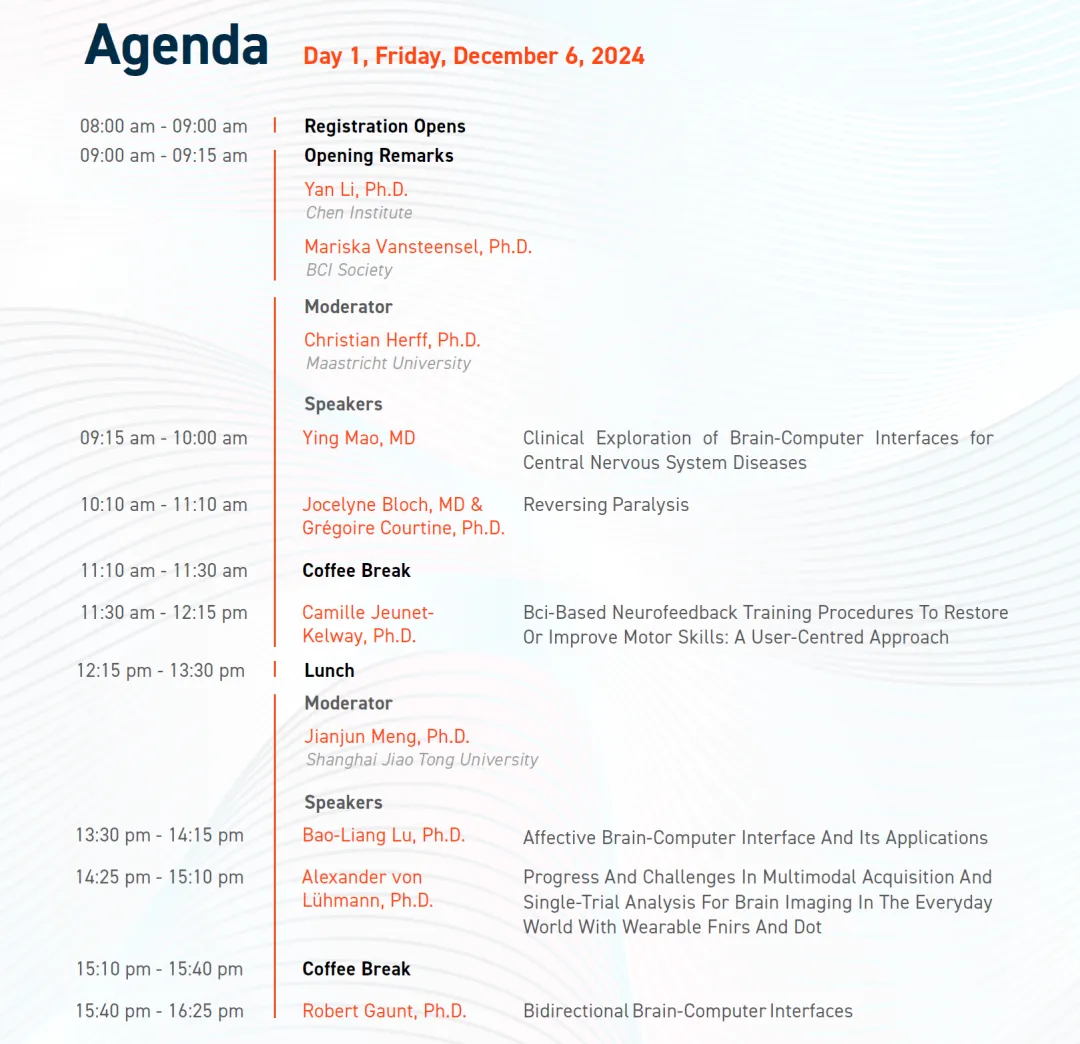
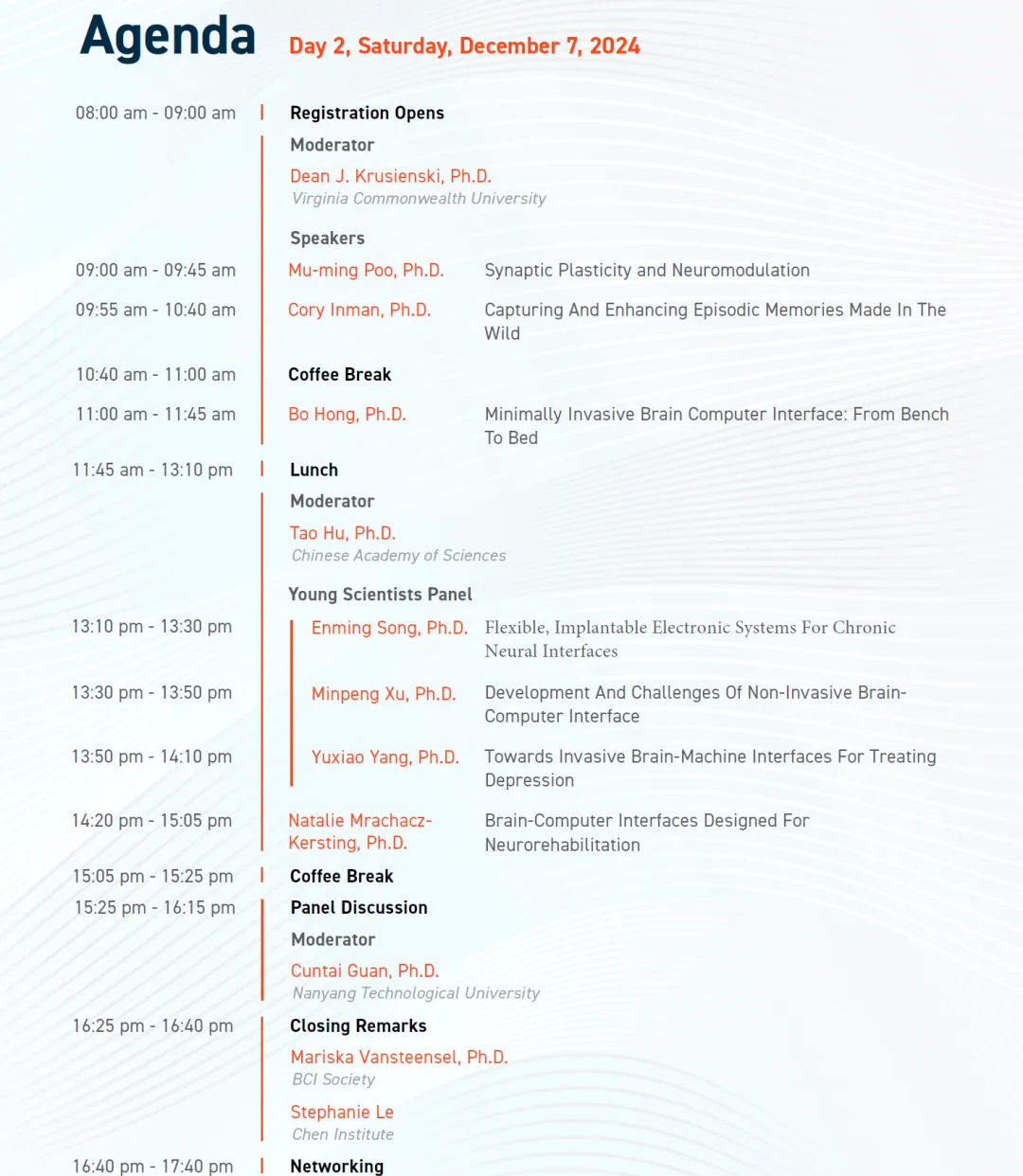
会议时间:
2024年12月6日-7日
会议地点:
上海斯格威铂尔曼大酒店
(上海市黄浦区打浦路15号,近徐家汇路,金玉兰广场内)
参与方式:
报名注册免费,食宿差旅请参会者自理;
会议席位有限,以主办方发送的参会确认短信为准;
报名注册以及了解更多信息,请扫描文末二维码。

扫码注册参会
关于BCI协会
BCI协会(The Brain-Computer Interface Society,BCI Society)是全球最具影响力的脑机接口学术机构,其旗舰活动International BCI Meeting自1999年在美国纽约首次举办以来,已成为该领域的标杆性学术会议。2023年第10届会议在比利时布鲁塞尔举办,吸引了来自全球39个国家和地区的237所实验室的近500位科学家。
关于天桥脑科学研究院
天桥脑科学研究院(Tianqiao and Chrissy Chen Institute, TCCl)是由陈天桥、雒芊芊夫妇出资10亿美元创建的世界最大私人脑科学研究机构之一,围绕全球化、跨学科和青年科学家三大重点,支持脑科学研究,造福人类。
TCCI与华山医院、上海市精神卫生中心设立了应用神经技术前沿实验室、人工智能与精神健康前沿实验室;与加州理工学院合作成立了TCCI加州理工神经科学研究院。
TCCI建成了支持脑科学研究的生态系统,项目遍布欧美、亚洲和大洋洲,包括学术会议和交流、夏校培训、AI驱动科学大奖、科研型临床医生奖励计划、特殊病例社区、中文媒体追问等。
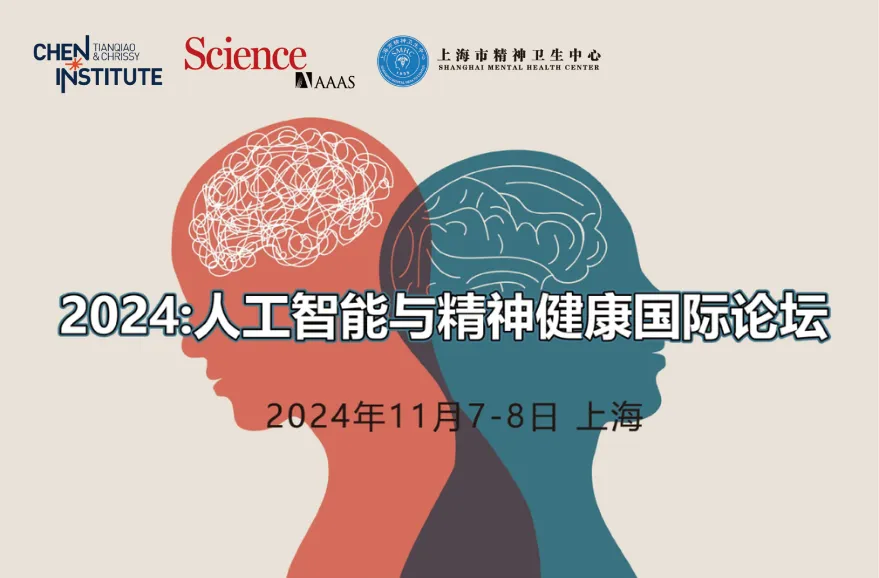
今天,天桥脑科学研究院(Tianqiao and Chrissy Chen Institute, the Chen Institute)联合《科学》杂志、上海市精神卫生中心共同宣布,将于2024年11月7日至8日在上海举办“人工智能与心理健康”国际论坛。
天桥脑科学研究院创始人雒芊芊表示:“近年来,人工智能实现了指数级增长,取得了惊人的突破,正影响现代生活和社会的方方面面。科学家和临床医生正在探索利用人工智能进行心理健康研究和治疗的可能性,就初步成果来看,其未来应用前景广阔。”
《科学》杂志的高级编辑Peter Stern表示:“《科学》一直处于新兴科学的前沿。我们将联手天桥脑科学研究院,与科学家和研究人员密切合作,释放人工智能在心理健康治疗和管理方面的巨大潜力。”
上海市精神卫生中心院长、国家精神疾病医学中心主任赵敏教授说,心理健康问题在全球范围内日益严峻,新一代人工智能大语言模型与精神疾病问诊可谓是天作之合,在这样的大背景下,我们和天桥脑科学研究院人工智能与精神健康前沿实验室正在开展重点项目攻关,同样期待通过这次会议与全球AI、精神健康领域科学家的跨学科交流,开启思路、造福患者。
本次论坛为期两天,将重点讨论如何利用人工智能开展精神心理研究及促进新型技术的临床转化应用,包括人工智能的现状及其近年来突飞猛进发展背后的驱动因素,人工智能在心理健康诊断和治疗方面的发展历程和未来应用前景。
作为全球最大的私人脑科学研究机构之一的天桥脑科学研究院,自2020年以来,与世界顶级学术杂志《科学》持续密切合作,每年合作举办脑科学国际学术论坛,今年还共同推出了AI驱动科学大奖。这是这两家机构第一次合作在中国举办学术会议。
该论坛相关讲者信息如下(按姓氏字母顺序排序):
Michael Breakspear:澳大利亚纽卡斯尔大学神经科学和精神病学教授
陈剑华:中国上海市精神卫生中心主任医师、教授
Philip Corlett:美国耶鲁大学精神病学副教授
Maria Eckstein:英国谷歌DeepMind研究科学家
Quentin Huys:英国伦敦大学学院计算精神病学和衰老研究中心副主任
李烨:中国科学院深圳先进技术研究院数字所所长、研究员
Nils Opel:德国耶拿大学医院转化精神病学杰出教授
Ioannis Paschalidis:美国波士顿大学工程学院特聘教授
眭亚楠:中国清华大学副教授
赵敏:中国上海市精神卫生中心院长、教授
您可以点击下链接阅读更多讲者计划演讲的内容:
https://www.cheninstitute.org/meetings/2024-ai-and-mental-health
如果您居住在境外,请用此链接注册:
https://www.eventbrite.com/e/950262128607
如果您居住在中国,则在此注册:
https://app.myhudong.com/mobile#/microstation_micro?acid=A7vcDJhENbTjupJ3kw&l=a
你也可以扫描下方二维码,查看更多会议信息: